GDPR-Compliant AI Support: Where Your Customer Data Really Ends Up
"If I let AI into my support, does my customers' data end up in a US cloud – and am I violating the GDPR?"
That's probably the question that made you open this article. And it's a good question. It's just framed the wrong way.
The fear behind it is legitimate. But the underlying assumption ("US cloud = automatic GDPR violation") doesn't actually match the law, and it doesn't point at the real risk either. The real risk isn't geographic, it's contractual and architectural: opaque subprocessor chains, training-on-customer-data clauses buried in the terms of service, and a dependency on a data-transfer construct that already has two dead predecessors on its record.
This article turns the question around: not "cloud or no cloud", but "who processes what, where, and under which contract". After that, I'll show you how a Germany-hosted, AI-native helpdesk dissolves this uncertainty entirely.
One note up front: this is context, not legal advice. For your specific case, talk to your data protection officer.
What actually happens to your customer data today
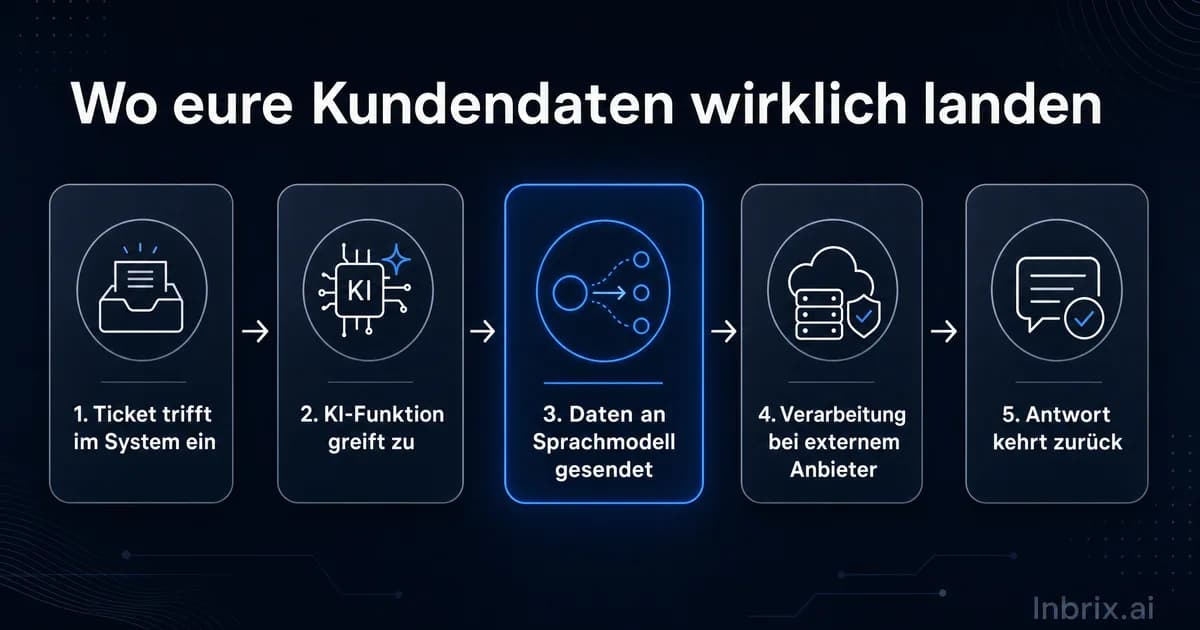
Before we talk about the GDPR, it's worth looking at the technical flow. When a customer writes a ticket and your tool sets an AI feature loose on it, this is typically what happens:
The ticket lands in the provider's database. Then an AI feature accesses it, say for a suggested reply, a summary, or an automatic classification. To do that, the content of the ticket is sent to a language model. In most cases that model doesn't run at the helpdesk provider itself, but at an external model provider (OpenAI, Anthropic, or a self-hosted model on AWS, Azure, or GCP). The generated answer comes back from there.
That sounds like a single step. But it's several handovers, and each one is relevant under data protection law.
The established tools weren't built for EU inference
Zendesk, Intercom, and Freshdesk layered their AI features onto ticketing infrastructure that dates back to a time when EU data residency wasn't a topic. The AI layer was added later, on top. That's a retrofit, not new construction.
What that means concretely for each individual provider's subprocessors is something you should never take from a blog article. Not even this one. These lists change frequently. Check the current DPA and subprocessor list of the respective provider yourself before you form an opinion. What can be said in general, though: wherever AI inference runs through US hyperscalers by default, the chain gets longer and harder to audit.
Sub-processing is the real attack surface
It's not "the cloud" as an abstract concept that's the problem. It's the chain of parties involved. Under Art. 28 GDPR, every subprocessor needs a valid contractual basis: the model provider, the hosting provider, the logging and monitoring service, the mail delivery.
The more hands touch the data, the harder it becomes to audit. That's exactly the practical argument for a Germany-hosted stack: fewer links in the chain. Not just "a different country".
Training on customer data – the line many cross without noticing
This is where it gets sharp. If a provider's terms of use allow them to use your support conversations to improve their models, then that's a new processing purpose. And a new purpose needs its own legal basis.
The Bitkom guide on AI and data protection and the EDPB opinion address this directly: personal data collected for "answering a support ticket" must not silently become training data for a foundation model. A standard DPA under Art. 28 usually doesn't cover that.
That's one of the most concrete checkpoints you can apply right away. And one that many SMEs overlook until it's too late.
What the GDPR actually requires (and what it doesn't)
Now to correcting the thinking error. The GDPR does not prohibit US processors. It requires accountability across the entire chain.
Art. 28 doesn't ban US processors – it demands traceability
The legal minimum: a valid data processing agreement (DPA), documented subprocessors, and enforceable instructions. A US provider with EU-only hosting and a solid DPA can be in a cleaner data-protection position than a European provider that routes its inference through an unnamed US subprocessor.
This nuance gets lost in most data protection debates. "US company" and "US data center" are not the same risk. Anyone lumping the two together is arguing past reality.
Purpose limitation and transparency – where AI tools get sloppy
The Baden-Württemberg State Data Protection Commissioner puts it clearly: data collected for a specific purpose may not be used for a different purpose without a separate legal basis. Answering a support ticket and training a model are two different purposes.
The EDPB opinion from December 2024 on AI models goes even further. It deals with the question of when a trained model itself can be considered "anonymous". That's a technically and legally unresolved question that an expert audience should be aware of. We're not in an area with clean, final answers here. We're in an evolving, contested field.
Automated decisions (Art. 22) – the sleeper topic
When an AI system independently decides to reject a refund, escalate a complaint, or classify a customer as a risk – without a human looking at it – that can trigger obligations under Art. 22 GDPR.
For the support context, this is barely settled. Take it for what it is: a point for your next conversation with your data protection officer, not a fixed rule. What matters is how you design your automation. An AI agent that makes suggestions a human approves is something different from one that autonomously affects customer rights.
The AI Act – less dramatic than the headlines suggest
Many articles throw the GDPR and the AI Act together and generate unnecessary alarm in the process. Most support chatbots fall into the "limited risk" category under Art. 50 of the AI Act. The central obligation there: transparency. Users have to know that they're talking to an AI.
That's a much lower bar than the "high-risk" category that dominates the AI Act debate. The obligations have been phased in since February 2025, with different deadlines for prohibited practices, GPAI models, and high-risk systems (source: IHK guidance). A support chatbot with a clear notice "You're talking to an AI assistant" already meets the core obligation.
An honest look at international data transfers
Now for the part most providers would rather skip.
Since July 2023 there's the EU-US Data Privacy Framework (DPF), an adequacy decision that legally secures data transfers to the US – for companies that have certified themselves. On paper, transferring to a DPF-certified US provider is therefore legal.
But look at the history. The DPF is the third attempt. Its predecessor, the Privacy Shield, was struck down by the CJEU in 2020 (Schrems II). Its predecessor, Safe Harbor, fell in 2015 (Schrems I). Two out of two predecessor constructs failed in court.
This isn't legal advice, it's an engineering-style risk assessment: just because something is legal today doesn't mean it's low-risk. If you base your architecture on a construct that has already been overturned twice, you're building on a foundation with a known history of breaking. And the DPF itself is legally contested too – whether it holds up permanently under renewed scrutiny is an open question.
The practical way out is unspectacular: if the processing takes place in the EU anyway, you don't need the whole transfer construct at all. No DPF, no Standard Contractual Clauses, no transfer impact assessment. The problem disappears instead of being managed contractually.
The five questions you should ask every provider
Here's the part you can save. Before you buy an AI support tool, ask the sales team exactly these five questions. The answers separate marketing from substance.
1. Where does storage take place – and where does inference?
Those are two different questions, and most providers only answer the first. A tool can dutifully host its database in Frankfurt and still send every single AI request to a US-based model API.
This is the most important, most inconspicuous insight in this whole article: hosting location and inference location are not the same thing. Ask explicitly about the location of inference, not just the storage location. If sales starts to stumble, you have your answer.
2. Is there a current, published subprocessor list?
Can the provider hand you a complete, up-to-date list of all subprocessors – model provider, hosting, monitoring, mail delivery, everything? If not, that's disqualifying for any serious data protection impact assessment (DPIA).
An open subprocessor list isn't paperwork. It's a trust signal.
3. Is "no training on your data" contractually guaranteed?
Ask specifically: is it in the DPA, or only in a blog post, an FAQ, or on a landing page? Many providers say it publicly but don't warrant it contractually. A marketing statement is worth nothing in a dispute. A clause in the DPA is.
4. What does the DPA actually look like?
Is the data processing agreement available, ready to sign, and complete? Does it cover the AI processing, not just classic ticketing? Read it before you sign, or have it read.
5. How is the automation designed – with or without a human?
Does the AI make autonomous decisions that touch customer rights, or does it make suggestions that a human approves? That's relevant for Art. 22 and for your own risk profile.
These five questions are a mini audit. Take them into your next sales call.
How inbrix answers each of these points
Now it gets concrete. inbrix is built as the German, GDPR-compliant alternative to Zendesk, Intercom, and Freshdesk. The difference isn't a data protection promise, it's the architecture. Let's go through the checklist.
Storage in Germany, inference in the EU
inbrix is hosted at Hetzner in Germany. The AI inference runs by default in EU mode at Scaleway in France (Paris). Storage location and inference location are therefore different – but both stay in the EU, even during AI processing.
That eliminates the entire transfer problem from the DPF section. No detour via US hyperscalers, no dependency on an adequacy decision with a history of breaking. If you deliberately want to use US frontier models, you can optionally enable a frontier mode; the routing then goes through a provider with standard contractual clauses and no training on your data – but that's an active choice, not the default.
Self-hosted monitoring – the chain stays short
Monitoring runs self-hosted, not via an external logging provider that in turn sits in a US cloud. That's exactly the "shorten the chain" from the sub-processing section. Fewer links, less audit effort, less attack surface.
Open subprocessor list
The subprocessors are disclosed. No guessing game, no black box. Exactly the trust signal that point 2 of the checklist demands.
AI-native instead of AI-retrofitted
And here lies the structural advantage. Legacy platforms bolt AI features onto an architecture from the 2010s that drags along old subprocessor relationships and data flows that were never meant for EU inference.
A new build can make "EU-only inference" the default, instead of a configuration toggle that no one ever flips. Being AI-native isn't just a product advantage here. It's a compliance advantage. The autonomous AI agents in inbrix work with two guardrails, each bot like a real team member, in an omnichannel inbox made up of email, chat, web tickets, and Shopware.
What you should do now
Let's sum up the practical steps, so you don't have to read the whole article again:
Take the five questions into your next provider call. Ask separately about storage and inference location. Demand the subprocessor list and the DPA before you sign, not after. Check whether "no training on your data" is contractually stated or merely advertised. And clarify with your data protection officer whether your automation touches Art. 22.
And one more reversal of thinking: GDPR compliance is no longer an annoying tax for German and European buyers. It's becoming the argument that decides deals. According to Bitkom (2026 survey, an industry association with its own interest in this narrative, to be weighed accordingly), six out of ten German companies see data protection as an advantage for AI development in Germany and Europe. Compliance as positioning, not as a brake.
In closing
If this checklist made you nervous about your current setup, that's not a bad sign. It means you're asking the right questions.
inbrix was built for exactly this standard: AI in support without the data protection uncertainty. Hosted in Germany, AI inference in the EU by default (Scaleway, France), an open subprocessor list, GDPR-compliant by architecture.
If you want to see what that looks like in your day-to-day work, take a look at inbrix and secure a spot in early access. No sales pressure – have a look and ask us the five questions we just gave you.